When Generative AI Becomes Your Content Team
Generative AI becomes a real content team when speed is matched with workflow, SEO logic, and editorial control. The winners will not be the teams that publish most, but the ones that turn research, drafting, and optimisation into reliable growth.
On this page
IBM generated roughly 200 images and more than 1,000 variations in an early Adobe Firefly marketing test, then saw the AI-led campaign outperform benchmark creative on engagement, showing how fast iteration can act like an always-on content studio when guardrails are in place (Axios). That matters to you because the same operating logic now applies to search content. Generative AI can research, brief, draft, and optimise at a pace most teams cannot match manually. The real choice is not whether you will use AI, but whether you will rely on a generic model or a workflow-led system that can publish reliably and improve SEO results.
From model to workflow: what you are really buying
Most teams start with a model and only later realise they needed a process. That distinction matters because publishing faster only helps if the output matches search intent, internal linking needs, and editorial standards. If you are assessing an AI SEO content tool, the real comparison is workflow depth, because the best AI content writer for SEO should feel like AI SEO content software built for repeatable delivery, not just smarter autocomplete, and that is what makes AI driven content creation commercially useful.
What is LLM, and why it is not your content team
When people ask what is LLM, the practical answer is simple: it is the language model layer that predicts and assembles text from patterns in training data. A model can draft headings, summaries, FAQs, and first-pass sections very quickly. But what is LLM missing in a production environment? It does not know your priority topics, conversion pages, refresh cadence, or brand rules unless you wrap it in a system. That is why a generic model can write fluent copy while still failing the requirements that AI generated content for SEO must meet if you want rankings and qualified traffic.
Why an AI SEO content tool outperforms prompt-only drafting
A true AI SEO content tool does more than answer prompts. It clusters terms, identifies intent gaps, builds a brief, suggests internal links, drafts metadata, and gives you a review layer before anything goes live. That is why an AI SEO content tool often beats manual prompting on speed and consistency, and why serious teams prefer AI SEO content software that turns repeated tasks into a documented process. In practice, the best AI content writer for SEO is the one that shortens time-to-market without lowering accuracy. The primary advantage of using generative AI in content creation is not that it replaces judgement; it gives your team more testing cycles per month.
Search has changed, so your metrics must change too

Faster publishing is only half the job now. You are competing in a results page where answers increasingly appear before the click. That means AI driven content creation must aim for visibility, citations, and assisted conversions, not just a bigger article count.
What is SEO when clicks are harder to win
If you still frame success as rankings alone, you will miss what is SEO today: visibility across classic listings, AI summaries, and branded follow-up searches. In a Seer Interactive study covering 3,119 queries across 42 organisations and 25.1 million organic impressions, click-through rates dropped sharply when AI Overviews appeared, while cited brands attracted more clicks than uncited ones (Seer Interactive). So when teams ask what is SEO now, the answer is broader than ten blue links. You need content that can earn presence in the answer layer and still capture demand when users keep researching across channels.
Why AI generated content for SEO must be citation-ready
This is where many vendor comparisons fall apart. Teams hunting for the best AI content writer for SEO often judge sentence quality first, but the stronger test is whether the workflow produces structured, evidence-led pages that search engines can cite. seoClarity found that AI Overviews appeared for about 30% of US desktop keywords by September 2025, mobile presence rose about 475% year on year, and more than 99% of sourced citations came from top-ranking pages (seoClarity). That means AI generated content for SEO needs clear definitions, scannable headings, original examples, and authority signals if you want it surfaced. Good AI SEO content software helps you format for retrieval, not just for readability.
Why governance matters more than volume
Scale without controls creates risk faster than value. Google states that generative AI can support research and structuring, but publishing many pages without adding value can violate spam policies around scaled content abuse (Google Search Central). That warning should shape how you run AI driven content creation. AI generated content for SEO needs fact checks, source review, human editing, and clear rules for when not to publish. If you are weighing the primary advantage of using generative AI in content creation, remember that speed only helps when quality controls protect trust, compliance, and search performance.
How to build a practical AI content team

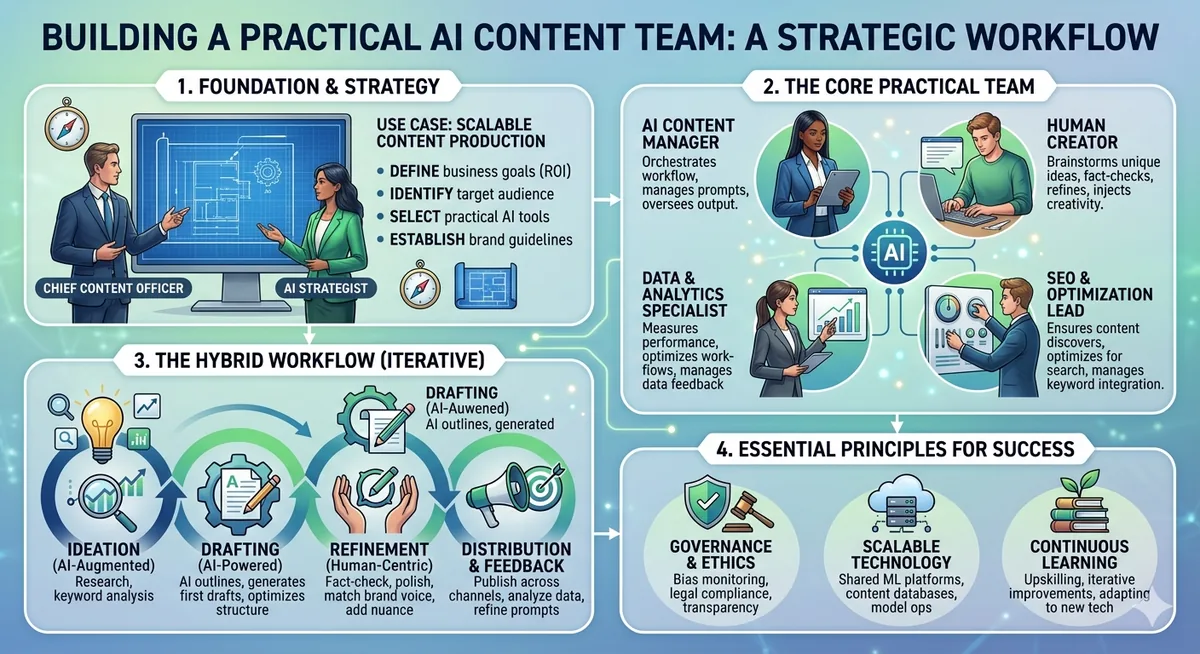
A working setup is less glamorous than most demos suggest. The best teams do not ask AI to “write a blog post” and hope for the best. They build a repeatable chain from research to measurement so that an AI SEO content tool becomes a dependable part of the editorial operation, and that is how AI driven content creation turns into a system rather than an experiment.
A weekly operating model for AI driven content creation
Start with keyword clustering and intent mapping, then turn each cluster into a brief with target questions, internal links, conversion paths, and source notes. Your AI SEO content tool should draft against that brief, not from a blank page, because briefs stop scope drift and keep messaging aligned with commercial goals. Next, edit for freshness, proof, and differentiation, then publish in batches so you can compare titles, openings, and schema. This is where teams rediscover what is LLM in practical terms: a fast drafting engine inside a controlled workflow. The primary advantage of using generative AI in content creation becomes obvious when one editor can supervise several well-briefed articles a day instead of one article every few days.
Where editorial automation starts paying back
If you want a practical example, RankPanda is a practical AI content platform that automates SEO research, briefs, and article production, and its guide to AI SEO content creation shows workflows, examples, and ideas to download a webinar or whitepaper for GDPR-compliant lead capture while helping you schedule demos. Use that kind of setup to connect briefs, drafts, revisions, and measurement in one place. When you compare options, the best AI content writer for SEO is rarely the one with the flashiest output; it is the one with the cleanest process, strongest controls, and fastest route from keyword to publishable page. The same rule applies to AI SEO content software: choose the platform that helps editors review claims, route links, and improve AI generated content for SEO over time. That is how you turn daily publishing into a compounding growth engine rather than a content pile.
The edge goes to teams that ship with control
Generative AI becomes your content team only when you pair drafting speed with SEO logic, editorial standards, and measurement. If you are still asking what is SEO in an AI-first search market, think less about raw page output and more about visibility, citations, and qualified follow-through. The best AI content writer for SEO will help you ship faster, but the lasting edge comes from an AI SEO content tool and AI SEO content software that turn research and production into a repeatable system. Put simply, the primary advantage of using generative ai in content creation is faster execution with better testing discipline. If you want to turn keywords into pipeline driving content, start here.
An article like this takes RankPanda minutes, not hours.
Run your site through the free analyzer and see what it finds. No signup.
Analyze your site