
The Quiet System Behind Winning Content
Winning content comes from a repeatable SEO workflow, not sporadic effort. Learn how AI writing tools, automation, clear briefs, connected publishing, and better metrics can reduce handoffs, improve quality, and drive steady organic growth over time
On this page
A strong content programme usually wins in quiet ways. In a Deloitte rollout spanning 16 geographies, the business saw a 68% rise in video views, a 16% rise in file downloads, and a 24% drop in homepage bounce rate within 60 days of migrating 2,000 Australian pages, according to an Adobe customer success story. That kind of lift points to a practical truth: results come from a system, not a single brilliant post. If you want a dependable SEO workflow, you need a way to turn research, briefs, drafting, publishing, and measurement into repeatable work, with AI writing tools and AI workflow automation reducing friction rather than adding it.
Why a quiet system beats sporadic effort
Content teams often lose momentum in places that never appear in a strategy deck. Handoffs break, briefs arrive late, metadata gets skipped, and internal links remain an afterthought. A reliable SEO workflow fixes those operational leaks so your publishing output becomes steadier and easier to improve.
Map the stages where work actually slows down
Start by mapping your current path from keyword idea to published page. Most teams have enough ideas; the delay sits between validation, briefing, drafting, review, and upload. Your SEO workflow should name each stage, the owner, the input required, and the definition of done.
This matters because AI tools only help when they plug into clear steps. If research lives in one spreadsheet, outlines in a document, and approval in a chat thread, even strong AI tools create more noise. You need a sequence that lets people and systems move without guessing what happens next.
Set clear inputs and outputs for every asset
A brief should not be a loose paragraph with a target keyword. It should specify search intent, priority subtopics, competitor gaps, internal link targets, title tag direction, schema opportunities, and conversion intent. When those inputs are standardised, your SEO workflow becomes easier to scale and your writers spend less time decoding expectations.
This is where AI writing tools and other SEO tools earn their place. Instead of asking a writer to start from nothing, you give them a structured prompt and a clear data pack. The result is faster drafting, fewer revision loops, and content that stays aligned with search intent and brand requirements.
Use metrics that show flow, not just output
Volume alone can hide weak execution. Ten posts published with poor linking, duplicate metadata, or shallow briefs will not give you the operating confidence you need. Measure cycle time, revision count, publish rate, indexing status, internal link coverage, and post-publish engagement across the whole SEO workflow.
Organic search data should be part of that feedback loop too. In an analysis of three SEO campaigns using RankPanda, the campaigns generated a combined 40,960 organic impressions and 1,284 clicks. All three expanded their organic search visibility from their respective starting points, despite beginning at very different levels.
The individual results make that pattern clearer. The largest campaign generated 32,900 impressions and 1,180 clicks at a 3.59% weighted CTR, with peak daily impressions rising 71.39%. A second campaign generated 3,740 impressions and 61 clicks at a 1.63% weighted CTR, while peak daily impressions increased 240%. The third generated 4,320 impressions and 43 clicks at a 1.00% weighted CTR, with peak daily impressions increasing 5,300% from a much smaller four-impression baseline.
Those percentages should not be compared directly because the campaigns started at different levels, particularly the third campaign. What matters operationally is the shared pattern: the content programmes created measurable search exposure, and that data then showed teams where further optimisation was needed.
Good SEO tools help you monitor those signals without relying on manual spot checks. If a page launches without the right metadata or misses key link targets, you should know before performance stalls. That shift, from counting articles to managing flow quality, is what makes content operations mature.
How AI fits into a practical content engine
The aim is not to hand your strategy to a machine. The aim is to remove repetitive work so your team can spend more time on judgement, positioning, and performance improvement. When people ask about the best AI tool for content writing, the real question is whether it improves a live SEO workflow while keeping control in human hands.
Use AI writing tools for briefs and draft scaffolds
The fastest win usually happens before the first draft. AI writing tools can cluster terms, summarise competing pages, extract recurring headings, and suggest outline structures that reflect intent. Used well, they help you produce stronger briefs in less time, which is why many teams see research and planning as the best first use case.
A capable AI content writing tool should also create structured draft scaffolds, not just generic paragraphs. You want title options, heading logic, entity coverage, FAQ ideas, metadata suggestions, and prompts for internal links. That makes the writer faster without reducing quality, because the brief still sets the rules and the editor still applies judgement.
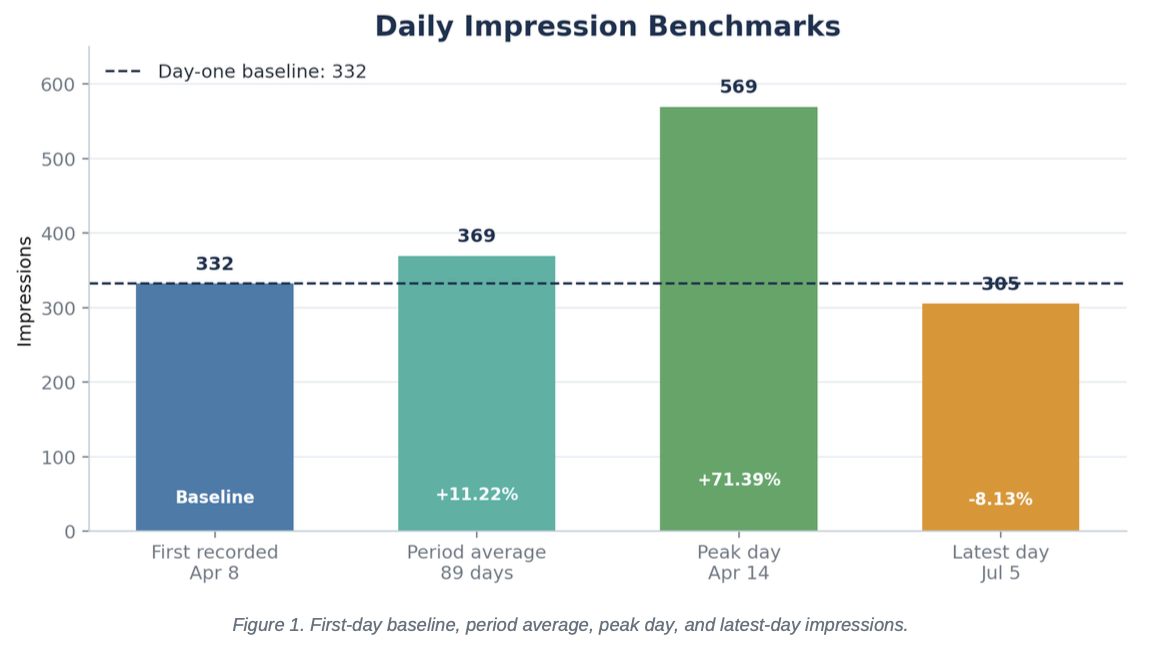
The RankPanda campaign data offers a useful example of what can happen when those activities sit inside a broader search process. In the first campaign, daily impressions moved from 332 at the starting point to a peak of 569 six days later, a 71.39% increase. Average daily impressions across the full 89-day campaign remained at 369.24, or 11.22% above the first recorded day.
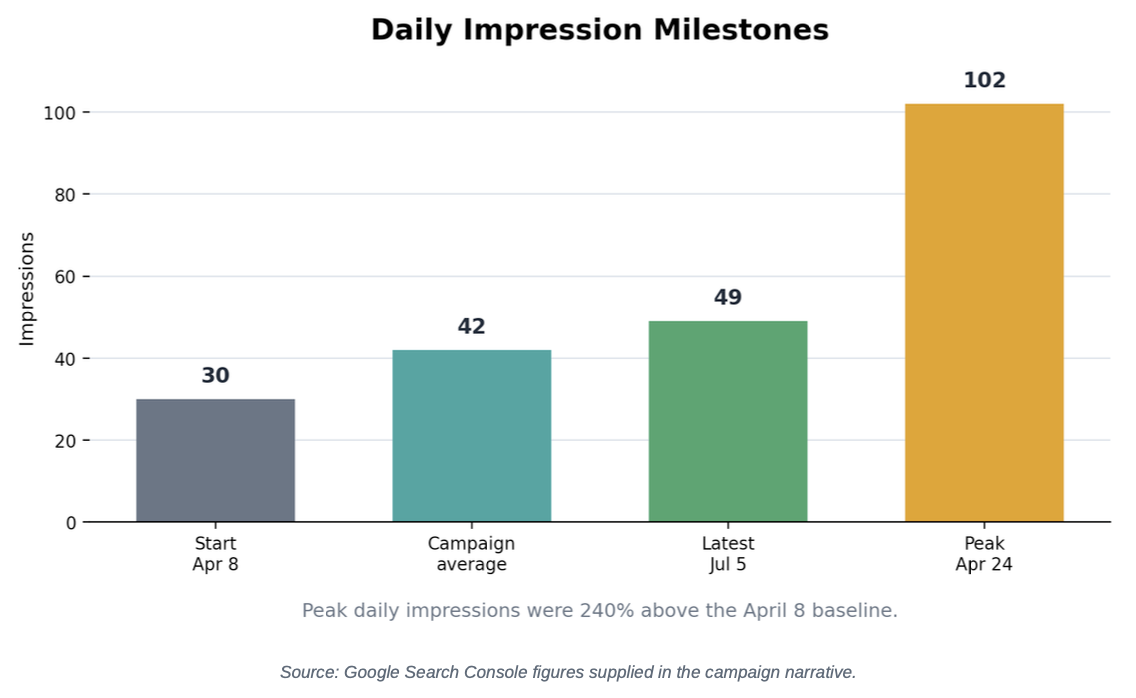
The second campaign started at only 30 daily impressions but reached 102, a 240% increase. Average daily impressions finished 40% above the starting level. More importantly, the final week reached 393 impressions compared with 155 in the initial partial week, an increase of 153.55%, and became the campaign's strongest weekly period.
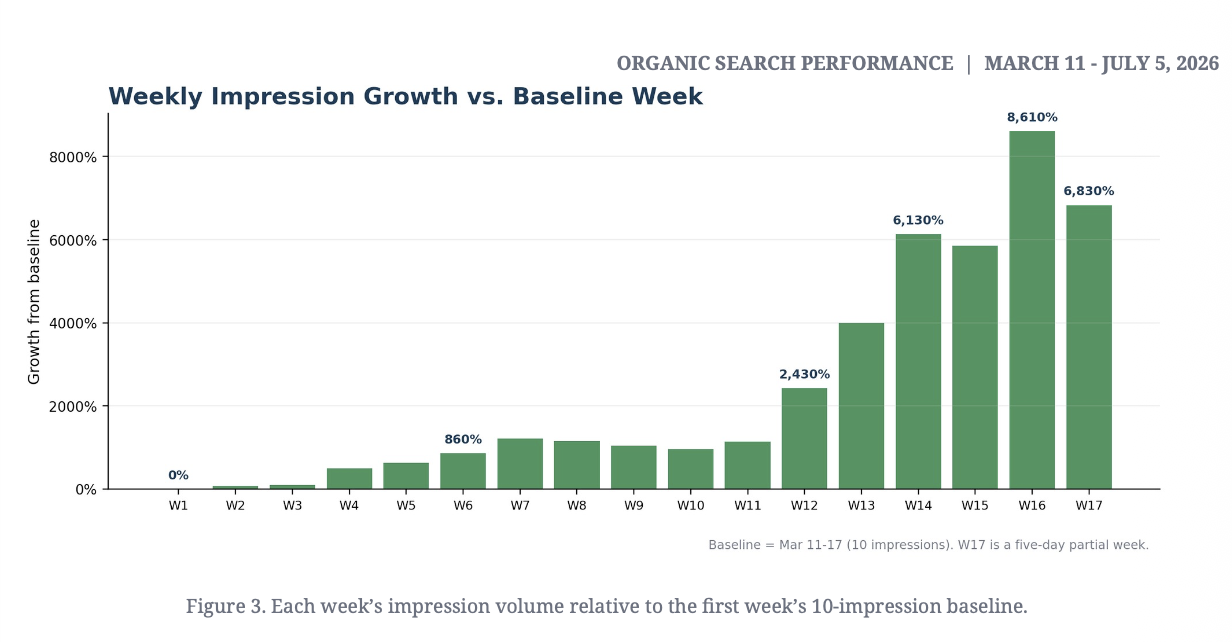
The third campaign started from an even smaller search footprint. Daily impressions rose from four to a peak of 216, equivalent to a 5,300% increase. Weekly impressions moved from a baseline of just 10 to a peak of 871, an 8,610% increase, while the final three weekly periods all remained above 500 impressions.
The percentages are amplified by the smaller starting points in the second and third campaigns, but the absolute figures are important too. They show that increased visibility was not limited to a single isolated spike. Search exposure expanded enough to create meaningful performance data that could then inform the next round of content and optimisation.
Connect research, publishing, and QA with automation
The bigger gain comes when tasks stop living in isolation. AI workflow automation can move approved keywords into briefs, push outlines to writers, flag missing metadata, and route finished pages to review. This is where content production becomes operational rather than improvised.
Your stack should connect SEO tools, your CMS, and review checkpoints in a single loop. That loop can check title length, missing alt text, weak internal linking, and publishing status before a page goes live. Used this way, AI workflow automation supports consistency, while AI tools handle the repetitive checks that often drain editorial time.
That loop should continue after publishing. The RankPanda results show why.
That creates a useful optimisation brief rather than a finished job. Teams can identify high-impression pages, improve titles and meta descriptions, strengthen internal links, expand useful content, and prioritise queries sitting within reach of stronger positions. An effective SEO workflow does not stop when an article goes live.
How to build a repeatable process without adding complexity
A repeatable engine does not mean adding more meetings or more software for the sake of it. It means reducing the number of decisions you make from scratch each week. The best SEO workflow feels lighter over time because each stage becomes clearer, faster, and easier to measure.
Compare tools by how well they reduce handoffs
When you compare platforms, look past surface-level drafting demos. The best AI tool for content writing is rarely the one that produces the most flamboyant copy; it is the one that supports research, briefs, drafting, optimisation, approvals, and publishing in one usable flow. If a tool cannot help you move from topic selection to publish-ready output, it will still leave your team stitching work together manually.
That is why many teams now assess an AI SEO content creation workflow with the same rigour they apply to analytics or technical SEO. A useful reference point is this guide to an AI SEO content creation workflow, which shows how a connected process can turn planning into steady output across research, briefs, drafting, and publishing.
RankPanda's three SEO campaign case studies provide another useful benchmark. Together, they generated 40,960 impressions and 1,284 clicks, but the more useful finding is how those results appeared across three very different starting points.
The first showed that an existing search footprint could reach a higher visibility ceiling, producing 32,900 impressions and 1,180 clicks over 89 days. The second showed more gradual momentum, generating 3,740 impressions and finishing with weekly impressions 153.55% above its initial partial week. The third showed what growth can look like from almost no existing visibility, moving from 10 impressions in its baseline week to as many as 871 in a week and generating 4,320 impressions overall.
These are live data from RankPanda's clients. It shows how what a RankPanda-assisted workflow looks like when evaluated using actual search performance rather than content volume alone: more search exposure, measurable visibility ceilings, and clear performance data for deciding what to optimise next.
That makes RankPanda a production-ready option for teams that want faster time-to-market and cleaner execution, especially if you want an AI content writing tool that also supports internal links, metadata, and performance visibility. In practice, the best AI tool for content writing will work well with your existing SEO tools and reduce handoffs instead of creating new ones.
Create a weekly operating rhythm your team can repeat
A strong operating rhythm keeps strategy close to execution. On one day, validate topics and assign intent. On the next, build briefs and collect SERP notes. Then draft, review, optimise content, publish, and check early signals in a predictable loop.
This is where AI workflow automation becomes especially useful. You can trigger briefs from approved topics, route drafts for review, and send reminders when metadata or links are missing. Over time, that rhythm turns your SEO workflow into a habit instead of a rescue mission, and it helps AI tools, SEO tools, and your chosen AI content writing tool work as one system.
The RankPanda case studies also suggest why measurement belongs inside that rhythm rather than at the end of it. One campaign quickly reached a higher level of search visibility, another finished with its strongest weekly performance, and a third moved from tens of weekly impressions into sustained volumes in the hundreds. At the same time, CTR and average-position data identified where the next round of improvements needed to happen.
If you are still deciding on the best AI tool for content writing, ask whether it makes this full cycle easier to run with fewer manual touches: research, create, publish, measure, optimise, and repeat.
Turn process into compounding growth
Winning content rarely comes from a burst of inspiration. It comes from a disciplined SEO workflow that keeps research, briefs, drafts, internal linking, metadata, publishing, and measurement moving in the right order. When you combine that discipline with AI writing tools, smart AI workflow automation, and connected SEO tools, you give your team a clearer path to consistent organic growth.
The RankPanda campaign results reinforce that point. Across three campaigns, 40,960 organic impressions and 1,284 clicks were generated. One campaign delivered 32,900 impressions at a 3.59% weighted CTR. Another increased peak daily impressions by 240% and finished with weekly visibility 153.55% above its initial partial week. The smallest campaign grew from four daily impressions to a peak of 216 and from 10 impressions in its baseline week to 871 at its weekly high.
The value is not simply the ability to produce content faster. The campaigns created measurable search visibility and, just as importantly, produced the performance data needed to decide what to improve next. That combination of creation, measurement, and iteration is why an AI content writing tool is most useful when it becomes part of the SEO system rather than another standalone writing app.
The important decision is not whether to use automation at all. It is whether your stack helps you create better inputs, faster approvals, and cleaner execution without losing strategic control. For most teams, the best AI tool for content writing is the one that strengthens process, and the right AI content writing tool should make your publishing engine simpler, not heavier.
If you are ready to turn keywords into pipeline-driving content, review the options and choose a setup that helps you ship high-quality pages with less operational drag.
An article like this takes RankPanda minutes, not hours.
Run your site through the free analyzer and see what it finds. No signup.
Analyze your site