
What 3 SEO Campaigns Reveal About RankPanda as an AI Content Writing Tool
Three RankPanda SEO campaigns generated 40,960 impressions and 1,284 clicks, showing measurable gains in organic visibility. See how an AI content writing workflow can turn research, keywords and optimisation into search growth teams can measure now.
On this page
AI writing tools are easy to judge on speed. The harder question is whether they help a brand become more visible in search.
Three Google Search Console performance reports from brands using RankPanda give us a useful answer. Across their respective reporting windows, the campaigns recorded a combined 40,960 organic impressions and 1,284 clicks. More importantly, all three reports showed measurable visibility lift from their starting baselines, although the shape and sustainability of that growth differed by brand.
That distinction matters. The best AI content writing tool is not simply the one that can generate the most words. It is the one that helps a team turn research, keyword strategy, structured content and optimisation into search visibility that can be measured.
RankPanda’s own workflow is built around that idea. The platform combines brand context, keyword strategy, automated research, structured article generation, metadata and CMS-ready exports rather than treating content generation as a standalone step.
So what happened when that workflow met real search data? Here is what the numbers show.
Three RankPanda campaigns at a glance
- Case Study 1: 32,900 impressions, 1,180 clicks, and a 3.59% weighted CTR. Peak daily impressions increased by 71.39%.
- Case Study 2: 3,740 impressions, 61 clicks, and a 1.63% weighted CTR. Peak daily impressions increased by 240%, while final-week impressions were 153.55% above the partial baseline week.
- Case Study 3: 4,320 impressions, 43 clicks, and a 1.00% weighted CTR. Peak daily impressions increased by 5,300%, while weekly impressions reached 8,610% above baseline.
The three campaigns started from very different baselines, so these percentage increases should not be treated as directly comparable results. What can be compared is the broader pattern: in all three cases, RankPanda-assisted SEO activity was followed by a measurable expansion in organic search visibility.
Case Study 1: Fast visibility activation at meaningful scale
The first campaign ran for 89 days, from April 8 to July 5, 2026. It generated 32,900 impressions and 1,180 clicks at a weighted CTR of 3.59%.
The most striking result came quickly. Daily impressions moved from a starting baseline of 332 to a peak of 569 on April 14, only six days later. That is a 71.39% lift. Across the full period, average daily impressions reached 369.24, staying 11.22% above the first recorded day.
That is a useful signal for marketers evaluating an AI content writing tool. The performance was not based only on one isolated peak: the full-period average remained above the campaign’s starting daily impression count.
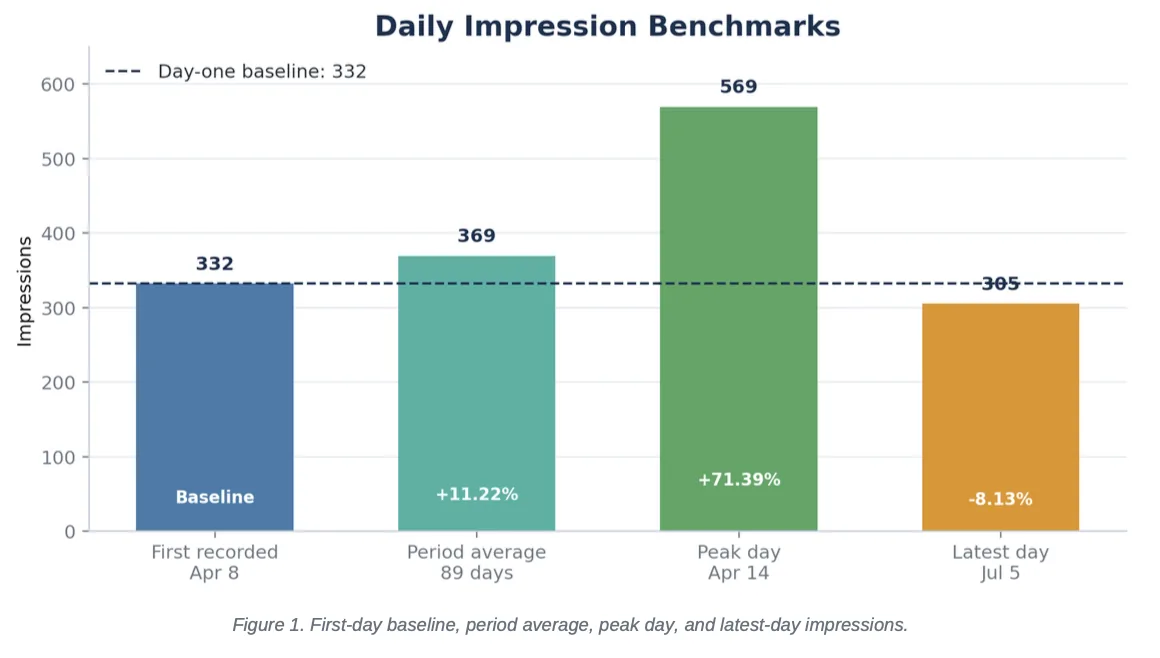
The result was not perfectly linear. The latest day finished at 305 impressions, 8.13% below the original daily baseline, while average position weakened from 6.84 in the first seven days to 7.44 in the final seven.
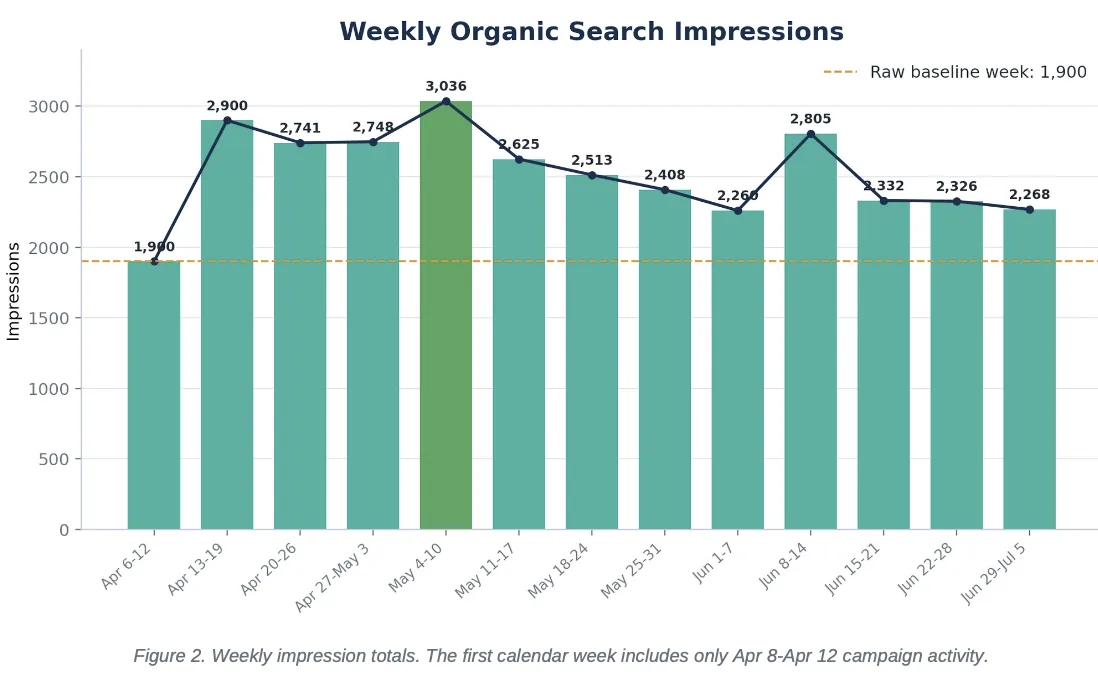
But, when you look closely in the weekly performance trend, it clearly shows a dramatic spike up with the weekly organic search impressions.
In other words, the campaign demonstrated an ability to create search visibility, but the next job is retaining that visibility and converting more of it into clicks.
That is how serious SEO tools should be evaluated: not by whether every chart always moves upward, but by whether they create enough measurable search opportunity to give the team something worth optimising.
Case Study 2: A stronger finish, not just an early spike
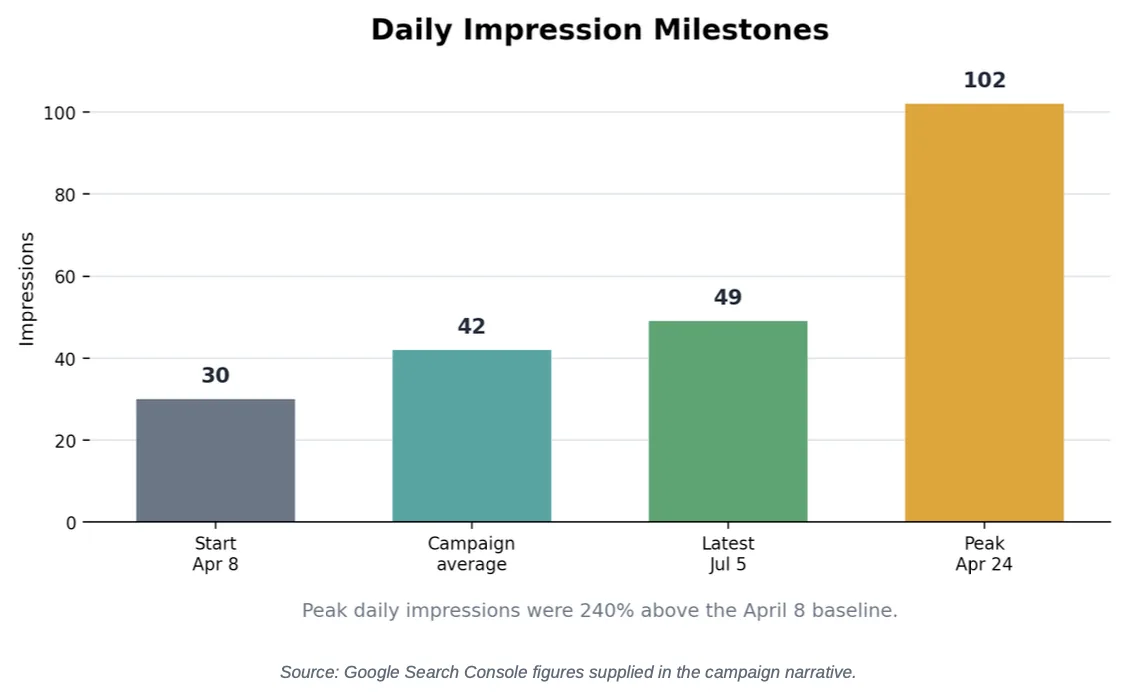
The second campaign tells a different story. It also ran from April 8 to July 5, but started from a much smaller base of 30 daily impressions.
By April 24, daily impressions reached 102 — a 240% increase from baseline. Average daily impressions across the campaign were 42, or 40% above the starting level.
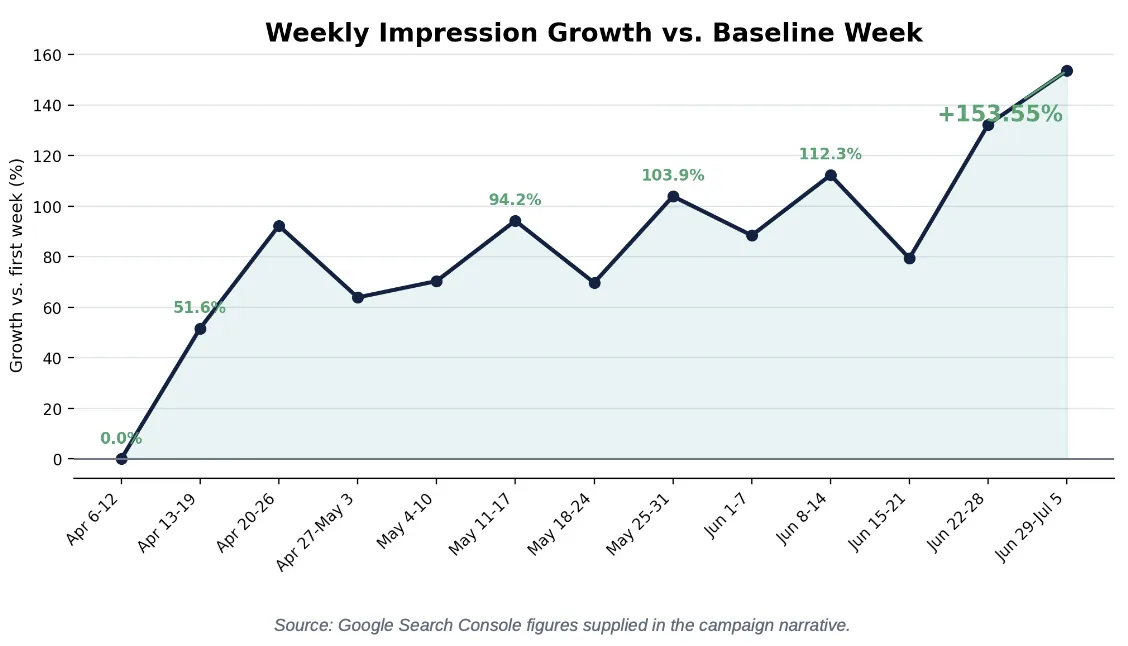
The strongest evidence, however, came from the weekly trend. The first partial week recorded 155 impressions. The final week reached 393 impressions, a 153.55% increase, and it was the strongest weekly period of the campaign.
The final seven dates also averaged 56.14 impressions per day compared with 36.86 during the first seven — a 52.3% improvement.
That is the kind of trajectory teams want from AI tools used for SEO: not just faster production, but a higher search visibility range over time.
There was still a conversion gap. Weighted CTR fell from 2.71% in the first seven dates to 1.27% in the final seven, while weighted average position moved from 5.82 to 7.43. More impressions were being created, but they were not yet translating proportionally into more clicks.
For a content team, that creates a clear optimisation brief: protect the pages earning impressions, improve titles and meta descriptions, strengthen internal linking and move high-impression queries into better ranking positions.
Case Study 3: Organic visibility scaled from tens to hundreds
The third campaign produced the most dramatic relative growth. Its reporting window ran from March 11 to July 5, 2026, beginning with just four impressions on the first recorded date.
By the latest date, daily impressions had reached 49, an increase of 1,125%. The single-day high was 216 impressions on June 25, equivalent to 5,300% growth from the four-impression baseline.
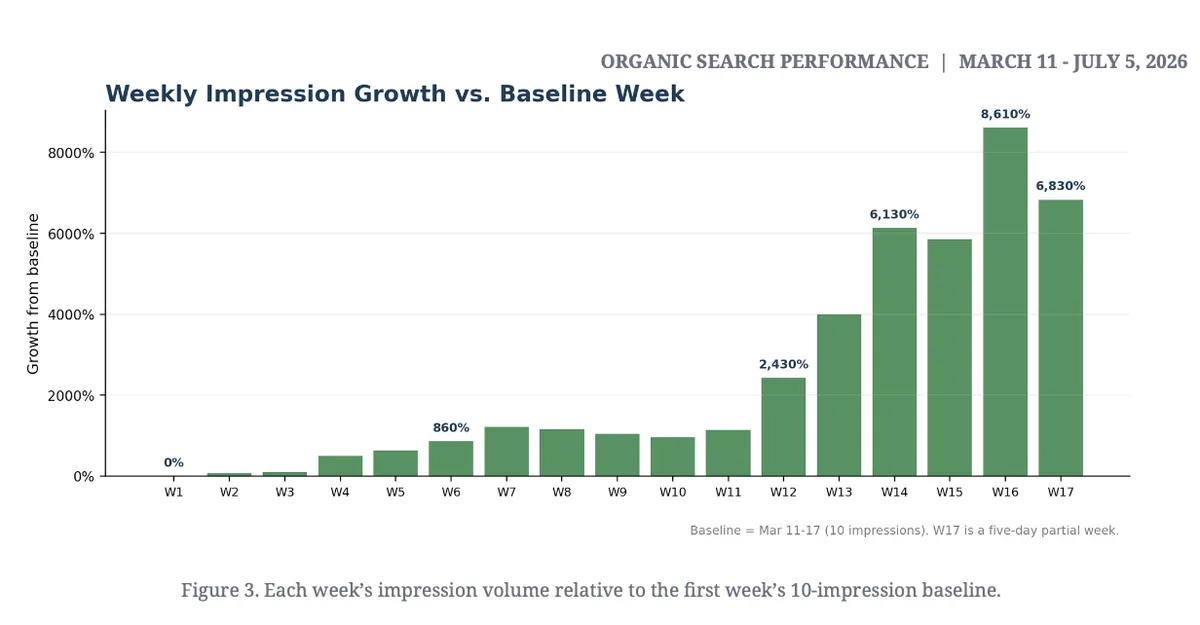
Weekly performance makes the shift easier to understand. The baseline week recorded 10 impressions. The highest week reached 871 impressions — an 8,610% increase. More importantly, the final three weekly periods shown all remained above 500 impressions.
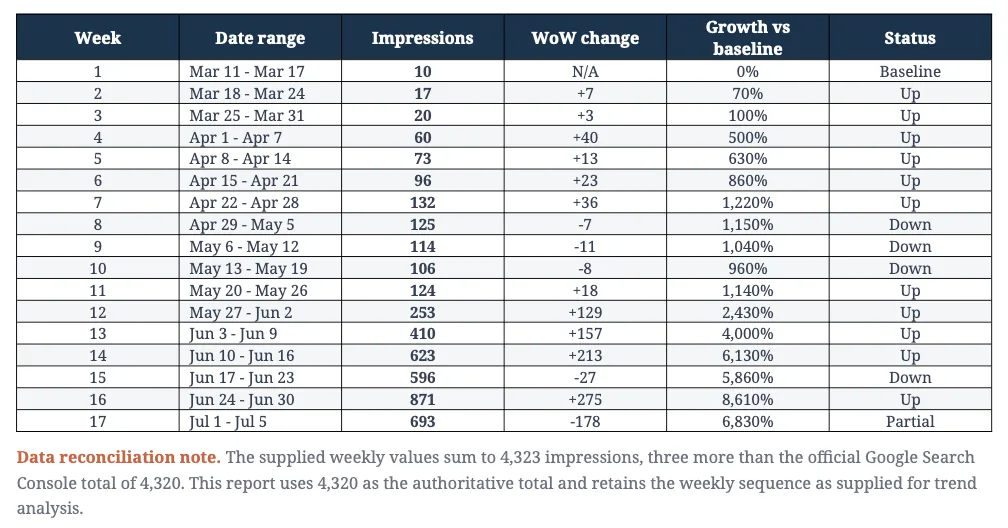
This is where context matters. A tiny baseline makes percentage growth look enormous, so absolute volume should always sit beside the percentage. Even with that caveat, moving from 10 weekly impressions to hundreds represents a material expansion in search presence.
The campaign generated 4,320 official impressions and 43 clicks overall. CTR was 1.00%, while average position moved from 9.31 in the first seven available days to 14.47 in the last seven.
Once again, the pattern is clear: visibility came first; click efficiency became the next constraint.
What these results say about RankPanda
Across three very different starting points, the common outcome was expanded organic visibility.
- Case Study 1 showed fast search-exposure activation at a larger existing scale.
- Case Study 2 finished with its strongest weekly visibility, suggesting that gains could build over time.
- Case Study 3 moved from a very small starting footprint into sustained weekly impression volumes in the hundreds.
That is a stronger way to evaluate AI writing tools than asking whether the copy “sounds good.”
Search performance gives you a measurable feedback loop. Impressions tell you whether content is earning visibility. CTR tells you whether search snippets and intent alignment are compelling enough. Position shows whether the content is competing strongly enough to capture demand.
RankPanda does not remove the need for SEO judgement. The reports reinforce the opposite. When visibility rises faster than clicks, teams still need to improve metadata, relevance, internal links, content depth and ranking quality.
The value of an AI content writing tool is that it can help create and systemise the content base that makes those optimisations possible.
Is RankPanda the best AI tool for content writing?
There is no universal best AI tool for content writing for every team. A better question is whether the platform supports the outcomes your content operation needs.
If the goal is simply to draft paragraphs, there are plenty of AI tools that can do that. If the goal is to create search-focused content inside a repeatable SEO workflow, RankPanda has a stronger case.
Its workflow connects brand context, keywords, research, article structure and metadata, while these three campaign reports show that the resulting SEO activity was associated with measurable increases in organic visibility.
The evidence is not a controlled experiment, and the reports themselves caution against claiming that every increase was caused solely by the campaign. In particular, the third report notes that without a control group or counterfactual analysis, the results support an effectiveness narrative rather than proof of sole causation.
But real-world SEO rarely arrives with laboratory conditions. What matters is whether a system produces a pattern worth scaling.
Here, the pattern is consistent: more search exposure, higher visibility ceilings and clear next-step data for optimisation.
For teams comparing AI writing tools and SEO tools, that is the benchmark that matters. The right AI content writing tool should not just help you publish faster. It should help you create content that earns enough visibility to measure, improve and turn into growth.
An article like this takes RankPanda minutes, not hours.
Run your site through the free analyzer and see what it finds. No signup.
Analyze your site